MOQ — minimum order quantity — is usually the first question a buyer asks a plush toy factory, and often the least well understood. A quoted MOQ is not an arbitrary hurdle. It is the point at which a production run stops losing money, and understanding what drives it lets you negotiate from a position of knowledge rather than simply asking for a lower number.
This guide explains how MOQ is calculated in plush toy manufacturing, how quantities affect your unit price, and how to structure a first order.
Why Factories Set a Minimum Order Quantity
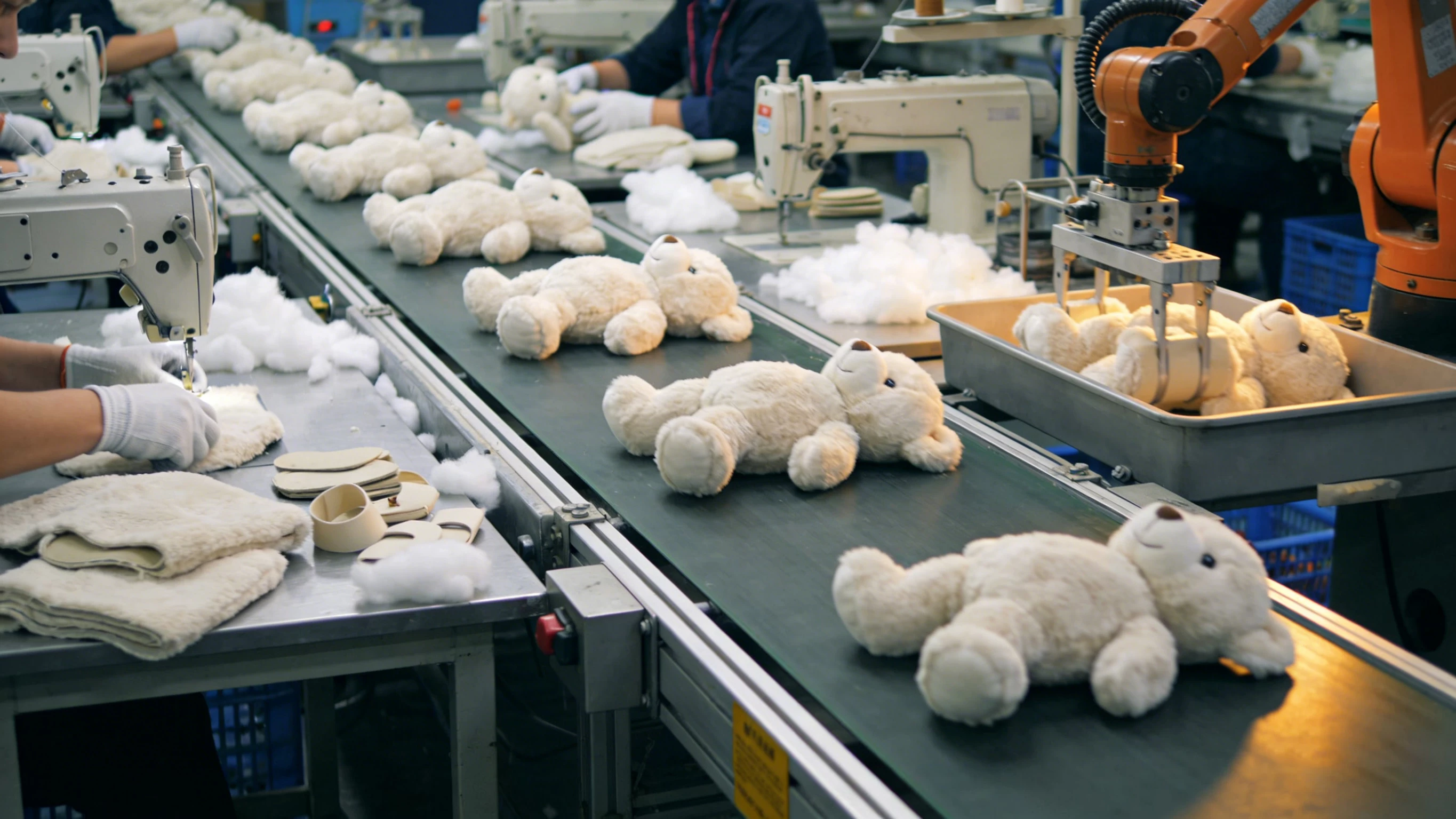
A plush toy is not printed or moulded — it is cut, sewn, stuffed and finished by hand. That changes the economics in four specific ways:
- Fabric has a minimum roll length. Plush fabric is bought by the roll. If your order needs 40 metres and the roll is 200 metres, the factory either absorbs the waste or charges you for it.
- Cutting dies and patterns must be made. A new shape requires a set of cutting dies. This is a one-time cost that has to be spread across the order.
- Printing and embroidery have setup runs. Whether it is a printed face, a woven label or an embroidered logo, each element has a setup step before the first good piece comes off.
- Production lines have changeover time. A line that switches styles loses time. Five hundred pieces justifies the switch; fifty usually does not.
For these reasons, most plush toy manufacturers set an MOQ somewhere between 500 and 3,000 pieces per design, depending on size, complexity and the number of custom elements.
What Raises or Lowers Your MOQ
Two orders of the same size can carry very different minimums. The variables that move the number are:
| Factor | Effect on MOQ | Why |
|---|---|---|
| Toy size | Larger toy = higher MOQ | More fabric and filling per unit, so the roll-length threshold is reached sooner |
| Number of colours | More colours = higher MOQ | Each colour is a separate fabric roll or a separate print setup |
| Custom printing | Raises MOQ | Print screens and plates have a fixed setup cost |
| Embroidery | Raises MOQ modestly | Digitising is one-time, but thread colour changes add changeover |
| Existing shape, new colourway | Lowers MOQ | Cutting dies and patterns already exist |
| Standard size range | Lowers MOQ | Factory already stocks the fabric and has the pattern graded |
| Simple construction (no joints, no electronics) | Lowers MOQ | Fewer assembly steps means faster changeover |
How Order Quantity Changes Unit Price
Unit price falls as quantity rises, but not evenly. Plush toy pricing typically moves in steps rather than a smooth curve, because each step crosses a threshold where a fixed cost is finally absorbed.
A typical progression looks like this:
- Sample and trial run (1–50 pieces): priced close to cost plus labour, because almost every cost is fixed. This tier exists to approve the product, not to make money.
- Small production (500–1,000 pieces): the first tier where fabric rolls and dies are fully used. Expect the largest single price drop here.
- Standard production (1,000–5,000 pieces): the working range for most independent brands. Savings continue but flatten out.
- Volume production (5,000+ pieces): further savings come mainly from fabric purchasing at scale and longer uninterrupted runs.
The practical implication: if you are near a threshold, adding a modest quantity often lowers your total cost per unit enough to be worth it. Ask your supplier where the next price break sits before you finalise your quantity.
Planning a First Order
For a brand placing its first plush toy order, the goal is to validate the market without tying up capital in inventory that may not sell. A workable approach:
- Start with two or three designs, not ten. Fewer designs means each one clears the MOQ more comfortably and you learn faster what sells.
- Use one colourway per design initially. Additional colourways can be added in a second order once the shape is proven.
- Ask for mixed-design counting. Some factories will count two or three simple designs toward a single MOQ if they share fabric and construction. It is worth asking.
- Confirm what the MOQ includes. Clarify whether it covers hang tags, poly bags, inner boxes and cartons, or whether packaging has its own minimum.
- Check shipping volume early. Plush toys are bulky. Five hundred large toys can fill a container faster than expected, and freight per unit can outweigh the savings from a larger run.
Questions to Ask Your Supplier About MOQ
When requesting a quotation, these questions will get you a more useful answer than simply asking for the lowest possible minimum:
- What is the MOQ per design, and does it change by size?
- Where are the price breaks above the MOQ?
- Is there a lower MOQ available for a trial order, and what does it cost per unit?
- Can multiple designs be combined to reach the minimum?
- Does the MOQ include packaging, or is that counted separately?
- How long does production take at the MOQ versus at double that quantity?
Summary
MOQ exists because plush toy production carries fixed costs — fabric rolls, cutting dies, print setup and line changeover. The number moves with size, colour count and customisation: simpler toys in existing shapes can start lower, while new shapes with printing and multiple colours require more. Plan a first order around two or three proven designs, ask where the next price break sits, and confirm that packaging and freight are accounted for before you commit.