When customers pick up a plush toy, they are judging the filling — even if they never think about it consciously. A well-filled toy feels substantial, springs back when squeezed, and holds its shape for years. A badly filled one feels lumpy, goes flat in the middle, and loses its character within weeks.
This guide explains the filling materials used in professional plush toy manufacturing, how they behave, and how to specify filling correctly.
What Filling Actually Does
Filling performs three jobs at once:
- Shape. It gives the toy its volume and holds the construction in tension so seams and features sit correctly.
- Feel. It determines how the toy responds to squeezing — soft and yielding, firm and structured, or springy and resilient.
- Durability. Good filling resists compression and clumping, so the toy still looks like itself after extended use and washing.
The Main Filling Materials
| Material | Character | Typical use |
|---|---|---|
| PP (polypropylene) cotton | Light, springy, economical, quick recovery | The industry standard for most plush toys |
| Polyester fibre fill | Softer loft, smooth hand feel, good resilience | Premium teddy bears, baby comfort items |
| Microfibre / siliconised fibre | Very smooth, silky, high loft | High-end gift plush, pillows |
| Memory foam or foam chips | Firm, structured, slow recovery | Seat cushions, shaped plush furniture |
| Bean filling (EPS beads) | Shifting weight, moulds to the body | Bean bag toys, weighted bases |
| Recycled PET fibre | Same performance as virgin fibre when specified well | Eco-positioned product lines |
PP Cotton: The Industry Standard
PP cotton — short for polypropylene cotton — is the most widely used filling in plush toys worldwide. It is light, inexpensive, machine-washable and recovers its shape quickly after compression.
Strengths: low cost, reliable supply, good loft, easy to stuff precisely.
Limitations: it can feel slightly synthetic, and lower-grade PP cotton compresses and clumps over time.
Quality here is not about the name of the material but its grade. Higher-grade PP cotton has longer, more uniform fibres, which resist migration and clumping far better than short, uneven fibre.
Polyester Fibre and Microfibre: The Premium Choice
Polyester fibre fill offers a softer, more luxurious hand feel than standard PP cotton. Siliconised microfibre takes this further — the fibres are coated so they slide against each other, producing an exceptionally smooth, high-loft fill that feels much more expensive in the hand.
Use it when: the toy is positioned as a premium gift, a baby comfort product, or a branded item where the feel is central to the value proposition.
Recycled Filling: A Growing Requirement
Recycled PET fibre — made from post-consumer plastic bottles — is increasingly specified by brands with sustainability commitments. When properly produced, it delivers performance comparable to virgin fibre, and it can be certified under the Global Recycled Standard (GRS), which many international buyers now require as documentation.
If your brand makes a recycled or eco claim, ask for the certificate, not just the material name.
Filling Density: Why Two Toys of the Same Size Feel Different
Two plush toys can use identical filling and still feel completely different, because density matters as much as material.
- Under-filled. Loose fabric, visible seams under tension, a toy that collapses when sat upright.
- Correctly filled. Smooth, rounded surfaces, firm enough to stand, soft enough to hug, springs back when released.
- Over-filled. Tight seams, stiff posture, a hard feel, and higher risk of seam failure during use.
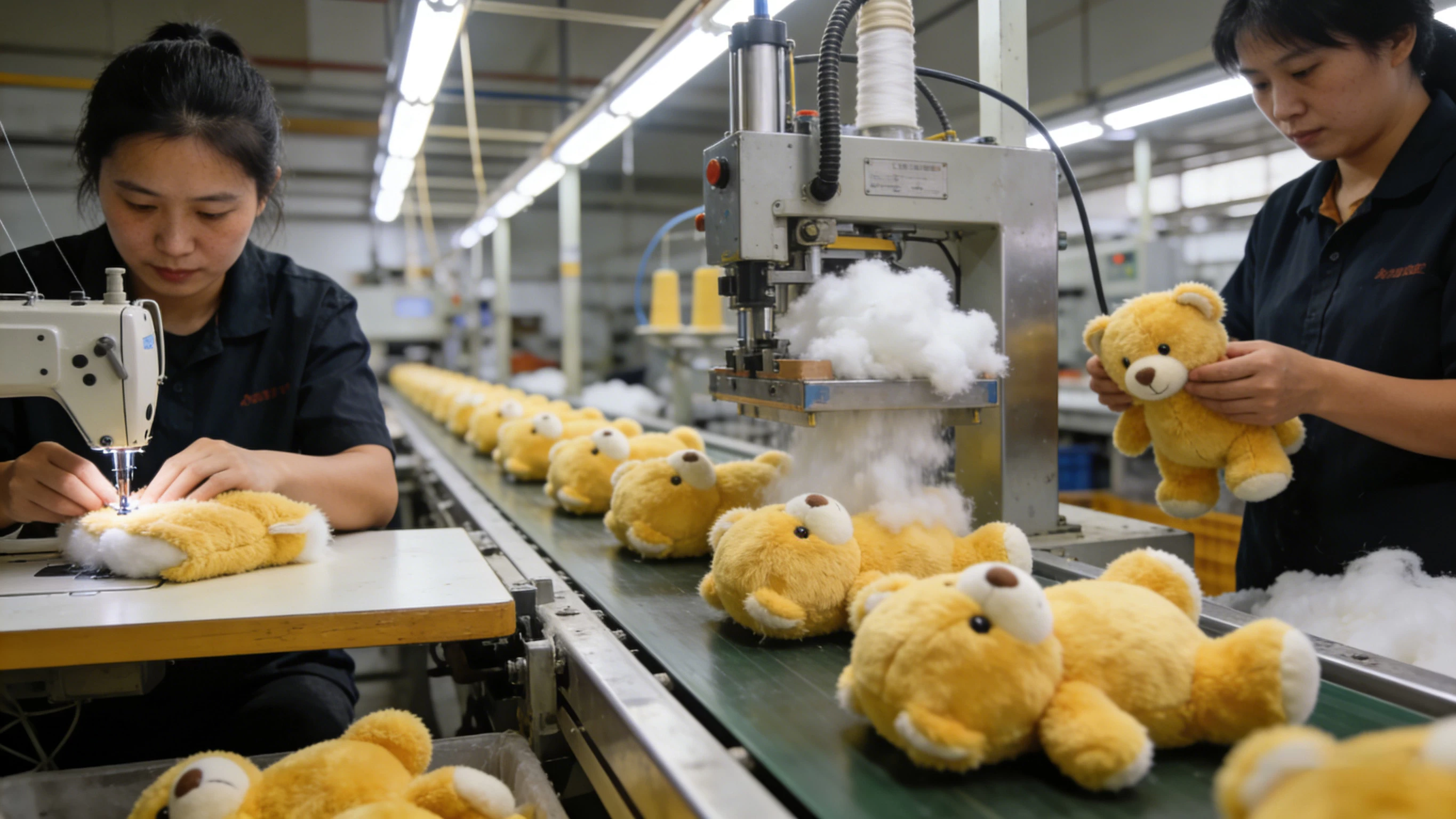
Good manufacturers control this by weight per unit and by stuffing in stages — torso first, then limbs, then head — rather than filling everything in one pass. This is one of the clearest differences between a factory that understands plush construction and one that simply fills and closes.
Filling and Product Safety
Filling is a regulated component, not just a soft material. Buyers should confirm:
- Cleanliness and hygiene. Filling must be free from foreign matter and produced under controlled conditions.
- Azo dyes and heavy metals. Required testing for most regulated markets.
- Flammability. Relevant for textile toys, particularly in the United States.
- Migration resistance. The filling should not work its way through seams or fabric over time — a quality issue that also becomes a safety issue with young children.
- Accessibility. For infant products, filling must be inaccessible through seams and closures, as specified by the applicable standard.
How to Specify Filling in a Purchase Order
To get consistent results across production runs, specify filling precisely:
- Material type — e.g. 100% polyester fibre fill, or GRS-certified recycled PET fibre.
- Grade and fibre length — not just "PP cotton".
- Fill weight per unit — in grams, per toy size.
- Firmness target — soft / medium / firm, referenced to an approved sample.
- Certification requirements — GRS, OEKO-TEX or equivalent, if applicable.
Always approve a physical golden sample. Filling feel cannot be specified adequately on paper — it has to be handled.
Summary
PP cotton remains the practical standard for most plush toys, polyester and microfibre fill deliver a noticeably more premium feel, and recycled PET is becoming a documentation requirement for eco-positioned brands. Just as important as the material is the density and the stuffing technique — which is where an experienced manufacturer makes the difference between a toy that feels average and one that feels genuinely well made.